Loading...
Be Local in Tunis: Medina, Carthage Sidi Bou Said
Tunisia
13/person
View All 3 PhotosView All 3 Photos
3
Overview
BudgetSoloWeekend TripCulturalHistorical
Discover Tunis like a local using buses and trains. Explore the Medina, the blue-and-white streets of Sidi Bou Said, and ancient Carthage while learning local routes, money-saving tips, hidden corners, and practical tricks beyond the usual tourist path.
My WhatsApp +216 26716988
BudgetSoloWeekend TripCulturalHistorical
Itinerary
Day 1 — Tunis Medina Getting to the Medina If you’re staying on the coastal side of Tunis, for example in CARTHAGE SIDI BOU SIDE LA MARSA , you have two easy local options. You can take bus 347 from a nearby bus stop, or use the TGM train, which connects La Marsa with Tunis and passes through the main coastal areas along the way. These options can save you money compared with taxis. If you’re staying in central Tunis, the Medina is right in the middle of the city. With Google Maps and a little walking, you can reach it quite easily. Entering the Medina Let’s say you arrive at Bab Bhar ( GATE ) the main entrance to the Medina. From there, you’ll find a large square with a fountain and two main street entrances. The entrance on the right, next to the Royal Victoria Hotel, mainly leads toward shops selling Chinese-made products and women's clothing. If your goal is to discover the traditional side of Tunis as a traveler, this isn't the route I would recommend. Instead, take the entrance on the left. This is where the experience becomes much more interesting. Follow the streets deeper into the Medina and you’ll eventually reach Al-Zaytuna Mosque, the historic heart of the old city. The mosque dates back to the early Islamic period of Tunis, with its present architectural form largely shaped by a major reconstruction in the 9th century. Its location makes it a natural starting point for exploring the surrounding souks, traditional streets and historic buildings. Local trick: Don't just follow the busiest street. The Medina is full of smaller passages and side streets, and some of the most interesting discoveries are away from the main tourist route. Take your time, look around, and let yourself get a little lost — that's part of discovering the real Medina. very important tip : Use Al-Zaytuna Mosque as your anchor One of the best tricks for exploring the Medina without getting completely lost is to make Al-Zaytuna Mosque your main reference point. You can explore different parts of the Medina, then always find your way back to the mosque before continuing to your next destination. From the mosque, you can make a short visit to the Ibn Khaldun House, associated with the famous Tunisian-born historian and philosopher Ibn Khaldun. After visiting, simply return to Al-Zaytuna Mosque and continue from there. You can do the same with Tourbet El Bey, an important royal mausoleum of the Husainid dynasty, where members of Tunisia's ruling family were buried. Visit it, then return toward Al-Zaytuna Mosque before exploring another part of the Medina. **A local coffee & pastry break ☕** From there, you can head toward Café M'Rabet, traditionally associated with the historic coffeehouse culture of the Medina. It's a good place to stop for a Tunisian coffee or tea and try a local pastry such as makroudh. For a simple pastry, coffee, tea or water, you can often keep the cost around 5 TND or less, while drinks such as juice or shisha can cost more, around 8–10 TND or more depending on the place. Important local tip: Be careful with cafés that heavily target tourists. I would personally avoid Café Panorama because of reported tourist-pricing concerns; always check the menu and prices before ordering. After your break, go back toward the area behind and above Al-Zaytuna Mosque and simply explore the small alleys and traditional souks. Don't worry if you get a little lost — that's part of the charm of the Medina. Just keep one thing in your head: **find your way back to Al-Zaytuna Mosque.** Once you're back at the mosque, you'll recognize the long street that leads toward the entrance where you started. Follow it straight back until you reach the large square and Royal Victoria Hotel area. This simple trick gives you the freedom to explore the Medina's small streets without constantly worrying about getting lost. Some other tips Most Tunisians are friendly and love helping travelers, especially when you approach the right people. Ask ordinary locals, rather than people who are waiting for tourists to ask them for help—such as waiters, market sellers, or workers in tourist areas. You’ll often get more genuine advice from someone simply going about their normal day. Ask young Tunisians who look like students. They can often help you with directions, transport, prices, or local recommendations. Don’t be afraid to ask. Sometimes the best local advice comes from a random person you meet on the street, in a café, on public transport, or around a neighborhood.
09:00
Al-Zaytuna Mosque
https://maps.app.goo.gl/UpkM4nRVFYUP6wMx6
Tourbet El Bey
https://maps.app.goo.gl/BLSRJa9kciWgqUYU6
11:00
Café El Mrabet
https://maps.app.goo.gl/86mkMqoT7vBLbpY77
Monument Place de la Kasbah
https://maps.app.goo.gl/dqC1yvdniPgztjqA9
12:30
The birthplace of Ibn Khaldun (دار إبن خلدون)
https://maps.app.goo.gl/BRuwQUrGi31SPi7KA
01:00
pecha street
https://maps.app.goo.gl/JVPGz3xx9Qo9q32SA
Accommodation
Auberge de Jeunesse - Médina de Tunis
https://maps.app.goo.gl/mXJTWZ7tvDzc3BJ99
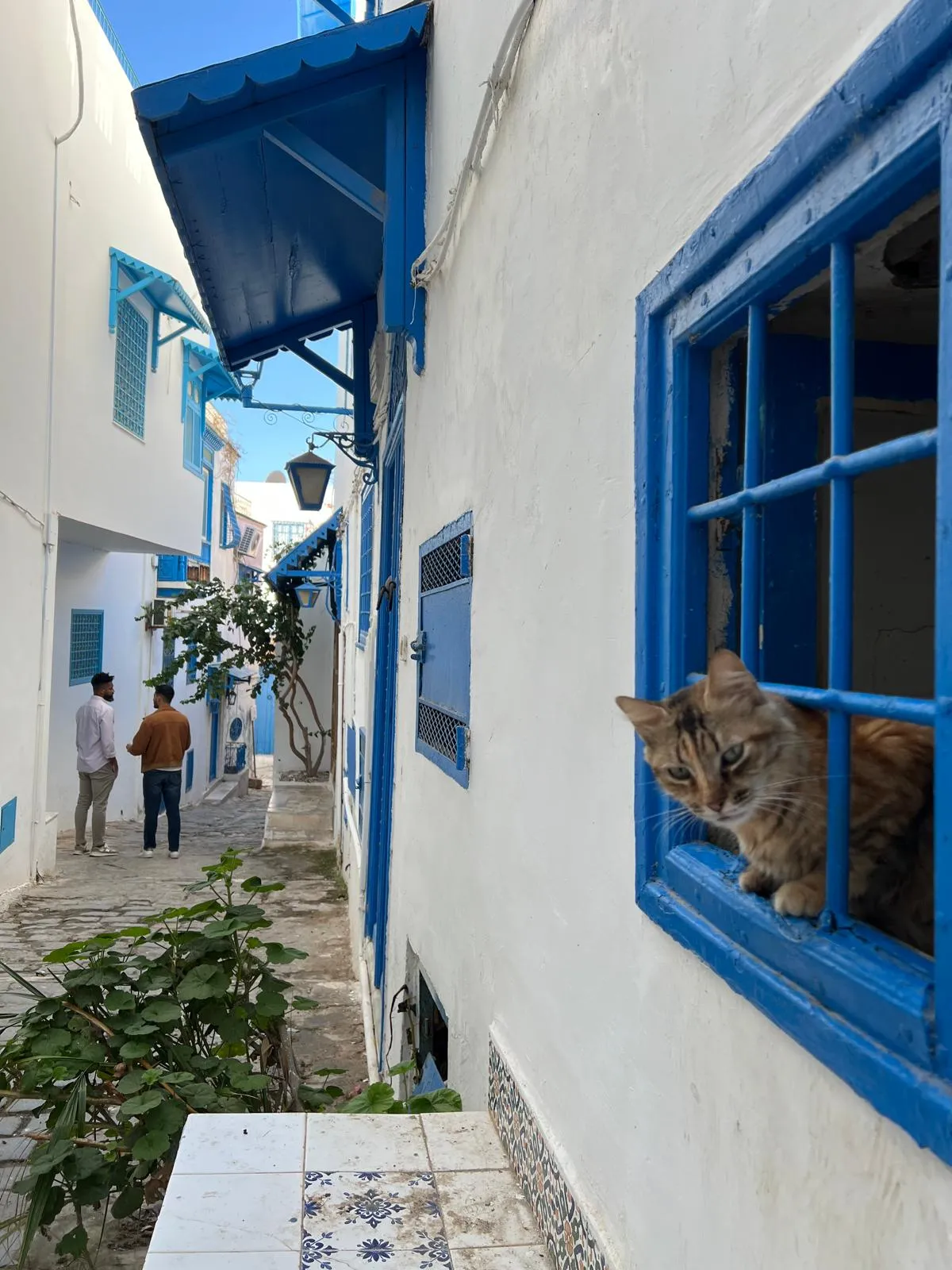
f you are coming from the Tunis Medina, the city centre, or another urban area, the easiest place to start is Tunis Marine Station. This is where you can find both the TGM train and bus 347, which head towards the northern suburbs, including Carthage and Sidi Bou Saïd. 📍 Tunis Marine Station: https://share.google/CyGZJPOkNddyFXlwr From Tunis Marine, you can take either the TGM or bus 347. Both routes pass through the Carthage area and continue towards Sidi Bou Saïd and La Marsa. Local tip: If you are visiting Carthage and Sidi Bou Saïd in the same day, don't think of them as two completely separate destinations. They are connected along the same northern suburban route, so you can visit the different Carthage sites first and then continue towards Sidi Bou Saïd. first arrival: carthage station your first stop will be carthage. if you are coming by tgm train or bus 347 from tunis marine, get off at the carthage hannibal station. this is the stop you want if you are starting your visit with the antonine baths. 📍 get off here: carthage hannibal station from the station, the antonine baths are within walking distance, so this is the best place to be dropped off if you are following this itinerary. Carthage Historical Stops 1. Thermes d’Antonin — Antonine Baths 📍 Impasse des Thermes d'Antonin One of the most impressive Roman remains in Carthage, located directly beside the Mediterranean Sea. 2. Port Punique de Carthage — Punic Ports 📍 Rue du 2 Mars 1934 The ancient commercial and military harbour area of Punic Carthage. 3. Tophet de Carthage — Punic Tophet 📍 Salammbô / near the Punic Ports An ancient sacred area associated with the religious traditions of Punic Carthage. 4. Site archéologique de Carthage — Byrsa Hill / Carthage Museum Area 📍 Byrsa, Carthage One of the most important areas for understanding ancient Carthage and its different historical layers. 5. Roman Theatre of Carthage 📍 Near Byrsa / Roman Villas A Roman-period entertainment complex and one of the major archaeological remains of Roman Carthage. 6. Roman Villas of Carthage 📍 Near the Roman Theatre Residential remains featuring important mosaics and evidence of everyday life in Roman Carthage. 7. Amphithéâtre de Carthage — Roman Amphitheatre 📍 Carthage archaeological zone One of the major Roman monuments of Carthage. The amphitheatre measures approximately 156 × 128 metres. After visiting the Carthage Amphitheatre, you can continue to Sidi Bou Saïd by bus. From the front of the amphitheatre, look for bus 347 going in the direction of Sidi Bou Saïd / La Marsa. Get off in Sidi Bou Saïd, the famous white-and-blue village overlooking the Mediterranean. This is a convenient way to continue the day without going back to Tunis. Local tip: Check the direction of the bus before getting on and ask the driver or a local passenger if it is going toward Sidi Bou Saïd. Once you arrive at the Sidi Bou Saïd bus or train station, you can start exploring the village. A good first stop is Dar Ennejma Ezzahra, the former residence of Baron Rodolphe d’Erlanger. ( https://maps.app.goo.gl/Fyr9EwwyxnD8GQmZ8) 📍 Dar Ennejma Ezzahra — Centre des Musiques Arabes et Méditerranéennes This is a great place to begin because it introduces you to the artistic, architectural and musical side of Sidi Bou Saïd before you start walking through the famous white-and-blue streets. You can visit the museum inside the palace, explore the traditional architecture and learn about Baron d’Erlanger's interest in Arab and Mediterranean music and art. After visiting the palace, you can continue walking uphill toward the heart of Sidi Bou Saïd, you will find one of the village's oldest and most famous bambalouni shops. (https://maps.app.goo.gl/AskcZfoCVwYkLLut8) Bambalouni is a Tunisian fried doughnut, usually served hot and covered with sugar. It's simple, inexpensive and delicious. It's also a great first introduction to Tunisian street food. You can grab one while walking around the village and get a small taste of the local food culture before continuing your exploration of Sidi Bou Saïd. Along the way, you will find several beautiful panoramic viewpoints overlooking the Mediterranean, with views of the coastline, sea and surrounding northern suburbs of Tunis. Take your time here. There is no need to rush from one viewpoint to another — the streets, blue doors, white houses and small corners along the way are part of the experience. 📍 Panoramic viewpoint: https://maps.app.goo.gl/ebmcM4PrS6e9P6rR9 📍Sidi Bou Said lighthouse https://maps.app.goo.gl/pF2P2Bcrg7LgUWhT6 📍 Belle Vue https://maps.app.goo.gl/cCfFnLba4m3JcU7e8 📍 Sidi Bou Said Viewing Point https://maps.app.goo.gl/yi5qinW6m9WzvWa99 📍 Café des Délices https://maps.app.goo.gl/UTMpdbYajjzLh3QS8
10:00
Visiting the Carthage Historical Sites
https://maps.app.goo.gl/6MPjaXk7V9mbLfRY9
14:00
Palace of Baron Rodolphe d’Erlanger
https://maps.app.goo.gl/NiTfRQJVNRmeNmnu9
03:00
Bambalouni & Mediterranean Views
https://maps.app.goo.gl/9T2EMtHzc3GVTWSJ6
03:30
Panoramic Views of Sidi Bou Saïd
https://maps.app.goo.gl/fj3KrR9HNY52GhfV6